The Matthew Effect: AI Coding Tools Make the Rich Richer
1. Background: What Have AI Coding Tools Changed?
Cursor, Copilot, Codeium—AI coding tools are now part of every developer's daily workflow. But beyond individual productivity gains, what impact do they have on the software ecosystem as a whole?
With Fei Gu, we studied this from a software evolution perspective.
2. The Finding: A Matthew Effect
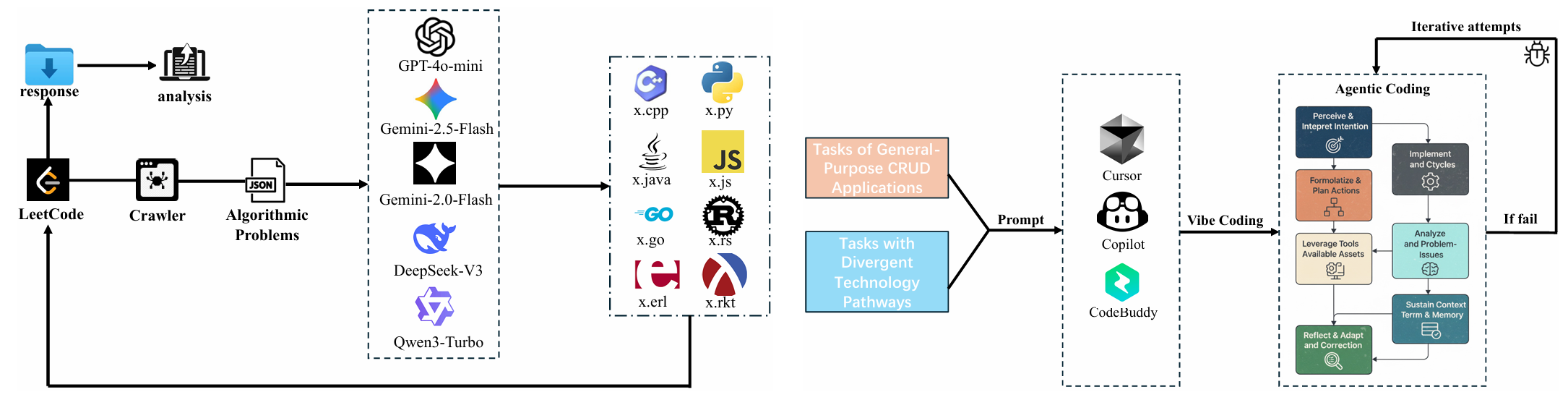
We analyzed AI coding tool behavior across two dimensions: programming languages and programming frameworks. The conclusion is clear: AI coding tools disproportionately generate code for already-popular languages and frameworks.
Why? Because LLM training data contains more and higher-quality code for popular technologies. AI tools are naturally "good at" what is popular.
The result? *The rich get richer, the poor get poorer*—popular languages become even more popular through AI assistance, while niche but promising languages struggle for attention due to lack of AI support.
3. What Does This Mean?
This is a hidden bias. AI tools claim to boost every developer's productivity, but they are quietly shaping the evolutionary trajectory of the software ecosystem. Technologies outside the "mainstream track" may be accelerated toward marginalization by AI's preference.
This paper was accepted at ICLR 2026. It sits at the intersection of my master's background (software engineering) and PhD focus (LLM safety).
4. Paper Info
- Title: The Matthew Effect of AI Programming Assistants: A Hidden Bias in Software Evolution
- Authors: Fei Gu, Zi Liang, Hongzong Li, Jiahao Ma
- Status: ICLR 2026
- Paper: https://arxiv.org/abs/2509.23261